
Rare Earths: Pollution from Rare Earth Mining in the Mekong Region and the Global Supply Chain
On 29 September 2025, in Mueang District, Nakhon Phanom Province, a network of civil society organizations jointly organized a public forum entitled “Rare Earths: Pollution from Rare Earth Mining in the Mekong Region and the Global Supply Chain.” The event was part of the Mekong–ASEAN Environmental Week 2025 (MEAW), held from 27–30 September under the theme “The Fake Green: Greenwashing Practices in the Region and People’s Power.” Participants included activists, youth, local community members, and academics from across the Mekong region and Southeast Asia.
From a River of Life to a Toxic River: Environmental Crisis from Mining in Shan State to the Mekong Basin
Pianporn Deetes, Campaign Director of International Rivers, stated that Chiang Rai Province—once celebrated for its pristine mountains and rivers—is now facing severe threats from cross-border mining activities that have profoundly affected both the environment and local livelihoods. Having lived in Chiang Rai for seven years, Pianporn has witnessed dramatic changes as an area once considered clean and suitable for raising a family has become a downstream recipient of pollution from gold and rare earth mining in Shan State, Myanmar. These activities have directly affected the Mekong River and the global rare earth supply chain.
The Kok River, a major tributary of the Mekong originating in eastern Shan State, has become a focal point of concern. In September 2024, local residents observed unusually turbid water that did not correspond with normal seasonal cycles. Satellite imagery analysis by the Shan Human Rights Foundation revealed large-scale open-pit mining operations in upstream Myanmar, including gold and rare earth mines. The circular pit patterns closely resemble those found in Chin State, a well-known rare earth mining area. Rare earth minerals are essential for modern technologies such as magnets used in electric vehicles, wind turbines, and even military equipment, including missile warheads.
Stretching 280 kilometers in total—157 kilometers of which flow through Chiang Rai and Chiang Mai provinces—the Kok River is bearing the brunt of these mining activities. Satellite imagery from Thai agencies and NASA confirms the presence of multiple mines located within one kilometer of the river. The number of mines has increased sharply, from just four before Myanmar’s 2021 military coup, to nearly ten in 2023, and almost twenty by 2025. Most operate without environmental controls. Regulatory collapse in Myanmar following the coup has driven small mining companies—previously tightly regulated in China—to relocate operations to Myanmar, resulting in severe environmental consequences.
Environmental impacts on the river are alarming. Investigations by Thailand’s Office of Environmental and Pollution Control Region 1 in Chiang Mai found heavy metal contamination—particularly arsenic—in the Kok River. Of ten sampling rounds, the first eight consistently exceeded safety standards, with some samples registering arsenic levels four to five times above permissible limits. Even the Mekong River itself, where the Kok flows in, showed arsenic contamination at Chiang Saen District. As a result, the Chiang Rai Governor issued a public warning advising residents to avoid direct contact with Kok River water. Communities such as Mae Yao Subdistrict were advised not to use contaminated water for washing vegetables or other household activities. Pollution was also detected in the Sai River, another heavily mined Mekong tributary.
Pianporn emphasized that these impacts extend far beyond local communities. In June 2025, the Mekong River Commission (MRC) detected elevated levels of arsenic and other toxins from the Golden Triangle area to Luang Prabang, noting that these pollutants are entering the food chain and threatening ecosystems and public health. With as many as 540 mining sites associated with rare earths and other minerals across the Mekong, Salween, and Irrawaddy basins, the crisis risks becoming one of the region’s most severe environmental threats.
The planned construction of new dams, such as the Pak Beng Dam in Laos, located just 97 kilometers from Chiang Rai and scheduled to begin construction in October 2025 under a 29-year power purchase agreement with Thailand’s Electricity Generating Authority (EGAT), may further exacerbate the problem. The dam’s reservoir could trap toxic sediments, directly affecting water quality for communities in Chiang Khong, Chiang Saen, and Wiang Kaen that rely on the Mekong River.
Despite these challenges, civil society in Chiang Rai continues to mobilize, submitting petitions to agencies including Thailand’s National Human Rights Commission and parliamentary committees. However, the lack of transparency from Myanmar—whether from military authorities or local armed groups—has made solutions difficult. Thai security agencies have confirmed the existence of at least 14 mining sites in the Sai River basin, some located directly on riverbanks, yet this information has not been fully disclosed to the public. Villagers in Mae Fah Luang District, standing on Thai soil, report clearly seeing mining sites across the border, along with chemical odors and symptoms such as throat irritation and dizziness, despite being several kilometers away from excavation areas.
Globally, the rare earth supply chain—heavily dependent on Myanmar’s resources—has been affected. The United Nations has established seven principles for sustainable mining, emphasizing that human rights and biodiversity must be at the core of development. For communities in Chiang Rai, these principles are deeply meaningful. “Nothing is more important than clean water, clean land, and the future of our children,” Pianporn stressed. The unchecked expansion of mining that exploits legal loopholes in Myanmar not only threatens the Mekong ecosystem but also the health and livelihoods of millions across the region.
As the Mekong continues to flow—carrying both life and toxins—the urgency of cross-border cooperation within the Mekong Basin has never been greater. Without serious dialogue and global regulation of rare earth mining, this vital river risks becoming a conduit for environmental and humanitarian catastrophe.
Human Rights in the Shadows: The Expansion of Rare Earth Mining in Laos
Chanang Amparak from the Mekong Freedom Network highlighted the alarming expansion of mining activities, particularly in Laos, which has emerged as a hub for mining investments to meet global demand for rare earths used in “green” industries such as electric vehicle batteries, wind turbines, and military equipment. This rapid expansion, however, has brought severe environmental and human rights challenges.
In Laos, mining has become a key economic driver alongside hydropower, fueled by foreign direct investment (FDI) from companies seeking vertically integrated operations—from extraction and processing to transport through Laos, Myanmar, and Vietnam. Laos is rich in rare earth resources, especially low-cost minerals suitable for industrial use, leading to rapid mine expansion. Yet weak governance has resulted in serious impacts. A notable example was a sulfuric acid truck used in rare earth processing overturning, underscoring lax safety and management practices.
Laotian laws, including the amended Mining Laws of 2010 and 2017 and the 2019 Environmental Impact Assessment (EIA) Decree, require mining projects to conduct EIAs or Initial Environmental Examinations (IEEs) and implement environmental management and monitoring plans. However, enforcement remains limited. Laos lacks sufficient skilled personnel and geological data, while complex approval processes—intended as safeguards—have become loopholes allowing some companies to operate without permits. Reports indicate that only one-third of mines in Laos are legally compliant, with the remainder operating without oversight, leading to chemical leaks and widespread ecosystem damage.
The impacts of mining in Laos and Myanmar extend beyond national borders into the Mekong River, the lifeline for millions. MRC investigations in 2025 found high levels of arsenic and other toxins affecting ecosystems and food chains from the Golden Triangle to Luang Prabang. With 540 rare earth–related mines across major river basins, the situation risks escalating into a major environmental disaster. Planned dams such as Pak Beng may worsen conditions by trapping toxic sediments and threatening water quality and public health.
A major challenge remains the lack of effective regulatory mechanisms and meaningful community participation in Laos, where discussions of human rights and community rights remain sensitive. Although some corrective actions—such as suspending mines after chemical spills—have been taken following community complaints, the overall situation continues to deteriorate. Civil society groups in Chiang Rai and across the region have sought remedies through national authorities and international organizations, but limited cooperation from Myanmar and capacity constraints in Laos have stalled progress.
Globally, surging demand for rare earths to support the clean energy transition is driving unsustainable extraction. The UN’s seven principles stress that human rights and biodiversity must be central to mineral development. For Mekong communities, clean water, safe land, and future generations are paramount. Without serious action at both regional and global levels, the Mekong and its dependent communities face an irreversible environmental and public health crisis.
Exploring Solutions: Cross-Border Accountability through International Law
Kornkanok Watthanaphum, a legal expert from EarthRights International, outlined international legal frameworks and enforcement challenges, emphasizing the responsibility of states and businesses to address transboundary impacts.
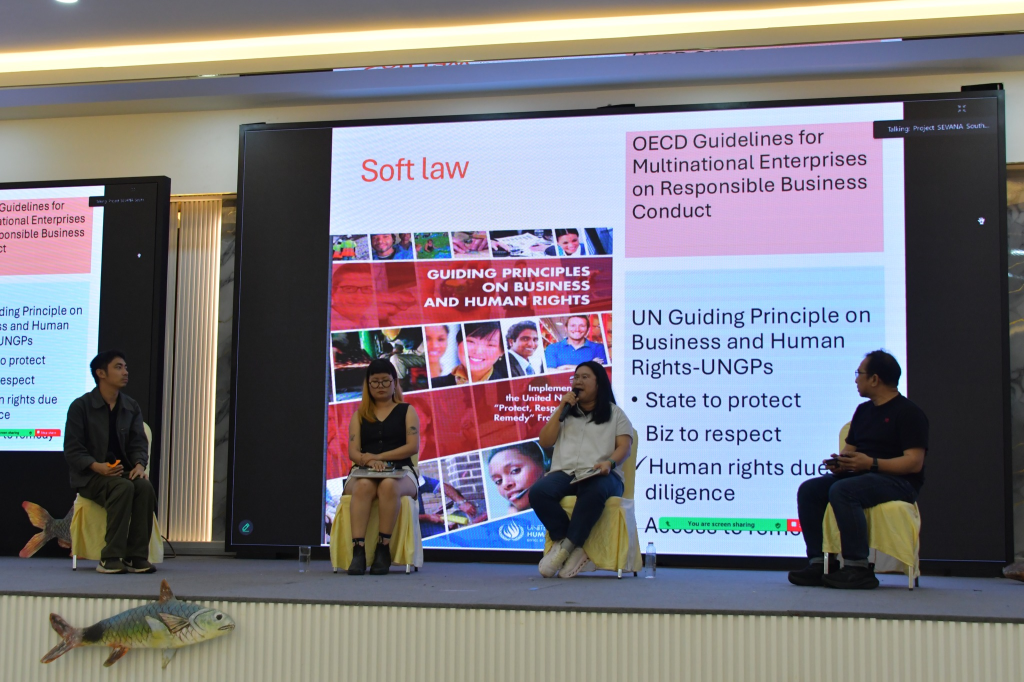
She cited Principle 21 of the 1972 Stockholm Declaration and Principle 2 of the Rio Declaration, which affirm state sovereignty over natural resources while imposing a duty to prevent environmental harm beyond national borders. This principle has been reinforced through landmark cases, such as cross-border smelting pollution from Canada affecting the United States, leading to joint commissions and tribunals that upheld the “polluter pays” principle. However, enforcement remains particularly challenging in the Mekong context.
Globally, China dominates the rare earth supply chain, controlling approximately 70% of mining, 85% of refining, and 90% of permanent magnet production, supplying markets in the United States, EU, Japan, and South Korea—especially Germany. China’s Rare Earth Management Regulation includes strict traceability requirements, but applies only domestically and does not cover Chinese companies operating abroad, such as in Myanmar and Laos—creating a critical regulatory gap.
In the EU, major legislation such as the Corporate Sustainability Due Diligence Directive (CSDDD), adopted in 2024 and fully effective in 2027, aims to reduce human rights and environmental risks across supply chains, including rare earth mining. The EU Battery Regulation requires disclosure of environmental, labor, and carbon footprint impacts. Germany’s Supply Chain Due Diligence Act mandates traceability and complaint mechanisms, while France’s Corporate Duty of Vigilance Law allows affected communities to sue companies for non-compliance, as seen in cases involving Syrian communities.
Beyond hard law, soft law mechanisms include the UN Guiding Principles on Business and Human Rights, the OECD Guidelines for Multinational Enterprises (with complaint mechanisms via National Contact Points), and standards such as the Initiative for Responsible Mining Assurance (IRMA).
Nevertheless, enforcement remains difficult. In 2025, the ETO Watch Coalition and networks from the Kok and Mekong rivers submitted complaints to UN Special Procedures to seek accountability for transboundary impacts. Kornkanok stressed that Thailand should use international forums, including the UN, to elevate the issue and urge China to extend regulatory control over overseas operations, not only in Myanmar and Laos but also in Africa and elsewhere. Addressing this crisis requires cooperation among all stakeholders to protect the Mekong and ensure a sustainable rare earth supply chain.
Tracing Toxic Minerals and the Geopolitics of “Fake Green” Supply Chains
Tara Buakamsri, former Director of Greenpeace Thailand and founder of Climate Connectors, highlighted the complex intersection of geopolitics, energy transition, and supply chain traceability. Rare earths are essential for clean energy technologies—EVs, solar panels, wind turbines, smartphones—as well as military equipment. Without rare earths, smartphones would not vibrate or display images.
Global energy transition targets net-zero emissions by 2050, requiring a 15-fold increase in wind power, 25-fold in solar, and 60-fold in EV batteries—driving extraction into fragile regions like the Mekong Basin.
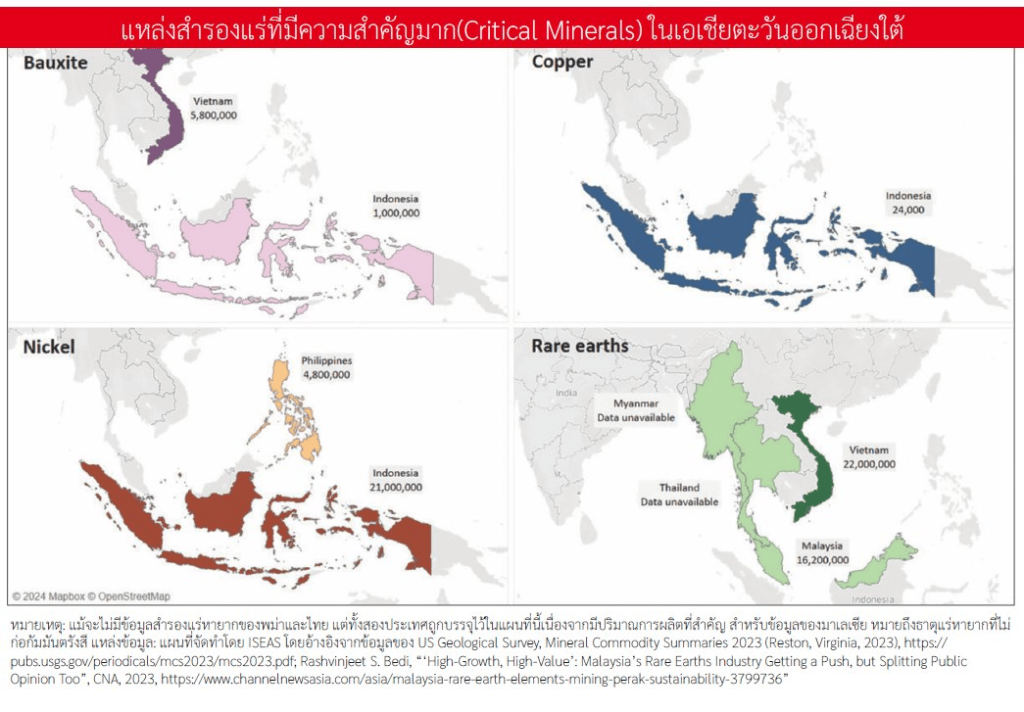
China controls nearly all rare earth processing and exports permanent magnets worldwide. Myanmar supplied 30–40% of China’s rare earth imports last year. Malaysia processes Australian ores before exporting to China, while Thailand exports small amounts of processed rare earths. Despite China’s import traceability system, once materials are exported, tracking them into end products becomes nearly impossible.
China’s own history illustrates the severe impacts of rare earth mining, with rivers such as the Yellow and Yangtze once heavily polluted. Massive consolidation and regulation followed to restore control and maintain geopolitical leverage. If China were to halt rare earth exports, the US and Europe would face immediate crises. Global remediation costs are estimated at 86% of Apple’s market capitalization, underscoring accountability challenges.
In Laos, rapid rare earth expansion without effective oversight has led to chemical leaks affecting ecosystems and communities. MRC findings confirm toxins entering the food chain from the Golden Triangle to Luang Prabang. Solutions require identifying key actors—mining companies and shareholders—to pursue accountability through UN mechanisms.
Tara stressed ASEAN’s lack of a clear position and effective mechanisms, calling on Thailand to leverage international forums to address transboundary impacts. Protecting the Kok and Mekong rivers and ensuring a sustainable rare earth supply chain requires cooperation across states, civil society, and corporations.
He further called for effective traceability mechanisms in ASEAN, the designation of No-go zones for mining in fragile areas like the Mekong Basin, and stronger home-state regulation—particularly by China—over overseas operations. Such measures would strengthen host-country governance and reduce environmental and human rights harms.
 ETOs Watch
Leave a comment