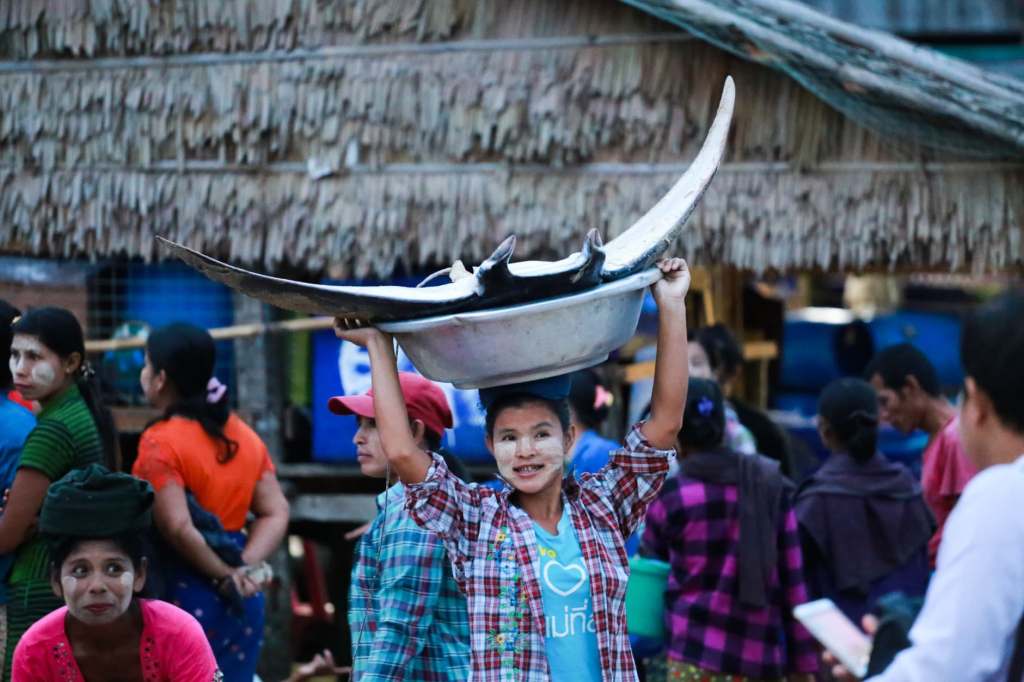
On 30 September 2025, in Mueang District, Nakhon Phanom Province, a network of civil society organizations jointly organized a public forum entitled “Dawei under Conflict: Special Economic Zones, Armed Conflict, Geopolitical Intervention, and Greenwashing.” The event was part of the Mekong–ASEAN Environmental Week 2025 (MEAW), held from 27–30 September under the theme “The Fake Green: Greenwashing Practices in the Region and People’s Power.” Participants included human rights and environmental activists, youth, community members, and academics from across the Mekong subregion and Southeast Asia.
Dawei under the Shadow of the Coup: A Project Shaped by Global Geopolitics
A researcher from the Dawei Development Association (DDA), explained that the Dawei Special Economic Zone (SEZ) project in Tanintharyi Region, southern Myanmar—envisioned as one of Southeast Asia’s largest petrochemical and industrial hubs—was launched in 2008 through a Memorandum of Understanding (MOU) between Myanmar’s former military government and the Thai government. A 75-year concession was granted to Italian-Thai Development (ITD) in partnership with Max Myanmar to develop a deep-sea port, cross-border road links to Thailand, industrial estates, power plants, and large water reservoirs.
Covering an area of 196 square kilometers and located approximately 315 kilometers from the Thai border, the Dawei SEZ is nearly eight times larger than Thailand’s Map Ta Phut Industrial Estate.
Even prior to the 2021 military coup, the project faced severe challenges, including land confiscation, human rights violations, corruption, and sustained resistance from local communities—particularly ethnic Dawei communities who depend on land, forests, and natural resources for their livelihoods. An estimated 17 percent of the local population was directly affected by the loss of resource bases, leading to deterioration in basic services, health conditions, and food security.
Communities experienced forced evictions, threats, and intimidation. Documented abuses include three cases of physical assault, twelve cases of threats, ninety-seven arrests, 271 instances of aerial patrols, and at least six other serious incidents. More than 60,000 people were forcibly displaced over a four-year period due to land seizures by the Myanmar military for project-related purposes.
Dawei thus became emblematic of state power exercised without the rule of law or public participation—fracturing communities and entrenching despair for more than two decades.
Just one month before the 2021 coup, the civilian government announced the termination of the concession agreement with ITD’s subsidiary. However, conditions deteriorated sharply after the coup, when the Myanmar military seized control of the Dawei SEZ area through militarization. Local communities were stripped of land rights and denied any voice in decision-making.
“This is not merely a consequence of development—it is the abuse of power without the rule of law,”.
Following the coup, the State Administration Council (SAC) under Min Aung Hlaing revived the project by turning to Russia as a strategic partner, seeking to bypass Western sanctions amid an intensifying civil war. In February 2025, Russian Minister of Economic Development Maxim Reshetnikov signed an investment MOU with the Myanmar junta covering the construction of a deep-sea port, coal-fired power plants, and an oil refinery in Dawei, under the framework of the Myanmar–Russia Trade and Economic Cooperation Commission.
In March 2025, Russian President Vladimir Putin and Min Aung Hlaing signed an agreement to develop a Small Modular Reactor (SMR) nuclear power plant with an initial capacity of 110 megawatts—expandable to 330 megawatts—by Russia’s state-owned company Rosatom, potentially to be located in Naypyidaw or Dawei to address Myanmar’s energy shortages and strengthen economic security.
Russia’s involvement reflects shifting global geopolitics. Isolated by Western sanctions following its invasion of Ukraine, Russia has positioned Myanmar’s military regime as a key partner in expanding its influence in Southeast Asia. The Dawei port—capable of handling vessels exceeding 200,000 tons—would provide Russia with a strategic maritime gateway to the region, linking to ports in Vietnam and potentially accommodating military fleets in the future. This would rebalance regional power dynamics involving China—previously interested but sidelined—and India, which is pursuing alternative connectivity projects.
For Thailand, once a primary investor, the project remains economically significant for regional connectivity linking Bangkok, Phnom Penh, and Ho Chi Minh City. However, it is increasingly overshadowed by armed conflict and human rights violations. Therefore local people in Myanmar have organized People Defense Force (PDF) to defend their land and demand democracy, viewing the military regime and mega-development projects as parallel threats to their future.
The DDA concluded that while Dawei is often portrayed as an economic catalyst, the absence of the rule of law and ongoing violence remain fundamental obstacles—particularly in militarized conflict zones. Without democratic governance and rights protection, the project risks prolonged stagnation amid intensifying geopolitical competition that could reshape mainland Southeast Asia.
Dawei as a “Fantasy Project” with No Place for People
An editor from Dawei Watch, described the Dawei SEZ as a project long promoted as Southeast Asia’s largest petrochemical and logistics hub. Initiated in 2008 through agreements between Myanmar’s former military regime, the Thai government, and Italian-Thai Development with local partners, the project aimed to develop a deep-sea port, cross-border roads, industrial zones, power plants, and reservoirs.
However, despite an official launch in 2010, progress was minimal. Satellite imagery from 2012 showed only preliminary infrastructure work. By 2018, under the civilian NLD government, the project remained stalled due to unresolved land grabs, human rights violations, and corruption. Dawei thus became a symbol of failed development that excluded local communities.
After the 1 February 2021 coup, the SAC revived the project through deepened ties with Russia. Following the February 2025 investment MOU, a subsequent agreement in March 2025 committed to building an SMR nuclear power plant by Rosatom. Despite uncertainty following a major earthquake in March, Rosatom has stated its intention to proceed.
Satellite imagery presented by Dawei Watch shows that in the two to three years following the coup, military installations expanded significantly. By 2024–2025, approximately 200 troops, police stations, and state security forces had been deployed in the project area—where previously there had been little permanent military presence. Communities were repeatedly displaced in a “Tom-and-Jerry” cycle of flight and return, resulting in tens of thousands of internally displaced persons.
Concerns escalated further with the proposed nuclear project. On 10 May 2025, the Karen National Union (KNU) issued a statement opposing the construction of an SMR in Dawei, warning of regional security risks—particularly for Thailand—drawing parallels to the 1990s–2000s Dawei gas pipeline project, which triggered armed attacks and displaced hundreds of thousands across the border. Mon groups also expressed concern over the possible involvement of Russian private security forces.
Geopolitical intervention became more evident when India’s ambassador visited Dawei in May 2025 to discuss the India–Myanmar–Thailand Trilateral Highway and a major logistics hub—part of India’s strategy to link South and Southeast Asia via Myanmar into Thailand—while Thailand and Japan remained largely silent.
Russian experts in Southeast Asia have described Dawei and its nuclear ambitions as a “fantasy project.” For local communities, it is seen less as economic development than as a tool of power projection—potentially turning Dawei into a geopolitical battleground.
Dawei Watch journalists, working with Democratic Voice of Burma (DVB), produce monthly reports in Burmese and English and train citizen journalists, as many professional reporters have been arrested or forced into exile. One local woman interviewed remarked:
“If Myanmar’s military works with Russia, all we will receive is suffering.”
This reflects deep collective trauma caused by development projects imposed without the rule of law.
Dawei Watch concluded that Russia’s post-coup involvement illustrates shifting global geopolitics. Myanmar has become a base for Russian military expansion in Southeast Asia, with Dawei port potentially serving as a naval gateway linking Vietnam and hosting military fleets—balancing China and India. Thailand must carefully assess cross-border impacts, as unresolved conflict and human rights abuses may prolong the project amid regional power competition.
Dawei and Cross-Border Solidarity amid Global Challenges
Wichai Juntavaro from SEM (Spirit in Education Movement), who has worked in Dawei for over a decade, highlighted community-led efforts to pursue sustainable alternatives by rejecting destructive mega-projects. SEM collaborated with Dawei communities to design community-based tourism, utilizing the region’s mountains, rivers, and hot springs.
In February 2020, before COVID-19 and the coup, the launch of the tourism initiative attracted thousands and offered genuine hope for sustainable development. However, both the pandemic and the 2021 coup brought these efforts to a halt.
Prior to the coup, SEM facilitated cross-border exchanges between Dawei communities and Thai networks, including Andaman Go Green, to share lessons from the failures of Thailand’s Map Ta Phut industrial estate—especially coal-fired power plants and associated health impacts. Dawei communities opposed fossil fuel plants under the SEZ and instead promoted renewable energy, such as solar power.
Engagements with Thai stakeholders, including Thailand’s Neighbouring Countries Economic Development Cooperation Agency (NEDA), raised concerns over the Dawei–Kanchanaburi road project, which remains unsuitable for economic activity. These discussions led NEDA to reconsider consultation processes and delay loans, temporarily postponing impacts on communities.
After the coup, the SAC revived Dawei with Russian backing. Wichai argued that Russia’s sanction-hit economy lacks the capacity to develop the SEZ meaningfully. The nuclear project, he warned, appears more aligned with military strategy—potentially involving submarine support or military basing—than with civilian energy needs.
Dawei lies just 350 kilometers from Bangkok and 300–400 kilometers from Ranong Province. Prevailing winds and ocean currents could easily carry cross-border impacts into Thailand. Combined with Myanmar’s internal fragmentation and escalating violence, large-scale Russian-backed investments may intensify conflict and forced displacement, turning Dawei into a depopulated zone visible only through satellite imagery.
Wichai called on Thai and ASEAN publics to urge their governments to reject Russian nuclear involvement and to support Myanmar civil society and local communities amid ongoing violence. What should have been an economic opportunity has instead become a tool of conflict and geopolitical rivalry.
Dawei and SMRs: “Fake Green” Energy and the Outstretched Claws of the White Bear
Tara Buakamsri, former Director of Greenpeace Thailand and founder of Climate Connectors, warned that Small Modular Reactors (SMRs)—marketed as safer, mobile, and low-carbon nuclear solutions—are not new technology but scaled-down versions of Generation III nuclear reactors. While SMRs typically produce up to 300 megawatts, large reactors generate 700–1,000 megawatts.
The International Atomic Energy Agency (IAEA) and nuclear powers such as the US and Russia promote SMRs as part of climate mitigation strategies, referencing COP28 commitments to triple global nuclear capacity by 2050. However, Thara noted that SMRs remain largely experimental, with only a few projects under construction in Russia, China, and Japan. More than 80 SMR designs proposed globally exist only on paper.
SMRs face serious challenges, including exorbitant costs and delays. In the United States, NuScale’s SMR project was canceled after projected electricity costs surged from USD 5 per kilowatt-hour to USD 20–100—far exceeding solar or wind. Construction costs have increased by 300% in China, 400–500% for Russia’s Arctic floating nuclear plant, and up to 700% in Argentina. Safety risks are compounded by complex reactor designs and unresolved nuclear waste management.
Rosatom’s potential development of two 55-megawatt SMRs in Myanmar is further complicated by geopolitics. Rosatom is widely regarded as a tool of President Putin’s geopolitical strategy. Russia–Myanmar military and energy cooperation predates 2007 and includes the use of Russian aircraft against civilians. The occupation of Ukraine’s Zaporizhzhia Nuclear Power Plant by Russian forces—with documented human rights abuses against staff—underscores the dangers of nuclear facilities in conflict zones.
Placing SMRs in conflict-affected and water-scarce areas, such as near Naypyidaw or Dawei, heightens risks for both Myanmar and Thailand. Beyond land seizures and violence against local communities, Rosatom’s presence could transform Dawei into a Russian military outpost, intensifying regional tensions involving China, the US, and India.
For Thailand, nuclear facilities across the border would raise profound environmental and security concerns—and could pressure Thailand to reconsider its own energy strategy toward nuclear power.
Dawei is thus not merely an SEZ investment project but a microcosm of geopolitical struggle, where global powers compete through infrastructure and energy. While the coup isolated Myanmar from Western engagement, it simultaneously opened space for Russia to deploy nuclear energy as a strategic bargaining tool in Southeast Asia.
“Opposing Rosatom and SMRs in this region is an urgent task for Southeast Asian civil society—to protect communities and the environment from threats that could fundamentally reshape the region,” Tara concluded.
 ETOs Watch
Leave a comment